What Japan’s care-robot experiments are really trying to solve
The most useful care technology does not replace a caregiver. It gives scarce people more time for the parts of care that machines cannot do.
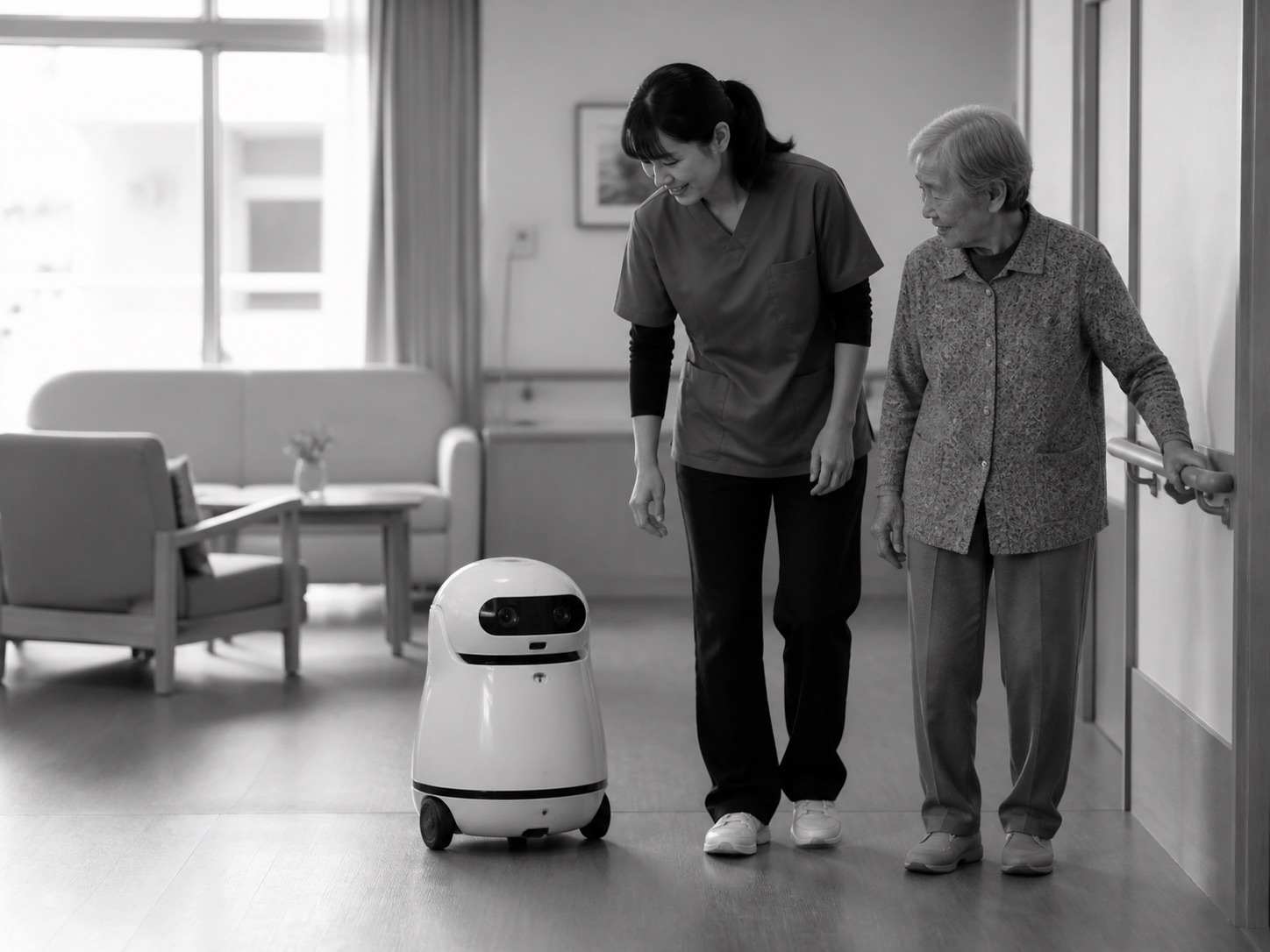
Japan is often presented as the country that will solve ageing with robots. The reality is less cinematic and more useful. Most care technology is not trying to create a humanoid replacement for a professional. It is trying to reduce the lifting, checking, recording, and night-time monitoring that consume scarce human attention.
A care worker’s day is a system
Care is a chain of small tasks: moving someone safely, checking whether a person has fallen, recording a change in condition, helping with meals, cleaning, communicating with family, and noticing when behaviour is different. A device can help with one link, but the benefit only appears if the whole workflow changes around it.
That is why an impressive prototype can fail in a real facility. If a sensor produces too many alerts, staff stop trusting it. If a robot requires a separate charging and cleaning routine, it may add work. If the data does not fit the facility’s records, documentation remains duplicated.
The human part is the point
The best use case is often subtraction. A transfer aid can reduce injury risk. A monitoring tool can make night checks more targeted. A documentation system can reduce the time spent copying observations between forms. The hours returned are valuable because care is relational: conversation, reassurance, and judgement cannot be compressed into an automated output.
This distinction matters ethically. Older people are not a labour problem to be optimised away. They are people whose autonomy, privacy, and preferences should shape whether a system is used. Technology that treats surveillance as a substitute for consent may improve a dashboard while making care worse.
Why adoption is slow
Facilities work under tight budgets and uneven technical capacity. Staff turnover makes training expensive. Procurement often rewards a device that can be purchased rather than a process that can be improved. Regulation and liability also matter: when something goes wrong, a human professional remains accountable.
Japan’s experiments are therefore valuable even when they do not scale immediately. They reveal which parts of care are standardisable, which require local adaptation, and which should remain deliberately human. The lesson for other ageing societies is not “buy more robots.” It is “redesign the work so technology protects the time and dignity that matter.”
Sources & methodology
The sources below anchor the explanation. They are starting points for verification, not decoration.
- 01 Ministry of Health, Labour and Welfare — Long-term care
Official context for Japan’s long-term-care system and the workforce pressures surrounding it.
- 02 Ministry of Economy, Trade and Industry — Robot policy
Government material on robotics, industry support, and the policy rationale for care-related technology.
- 03 World Health Organization — Decade of Healthy Ageing
A broader framework for judging technology by whether it supports the dignity and agency of older people.