01 / Technology
Technology & systems in Asia
Technology is never only about the tool. This desk follows the systems, incentives, and institutions that decide what technology becomes in practice—from AI and media to infrastructure and industrial capacity.
Start here
Media & systems · Infrastructure & institutions · Technology & systems · Work & society · Technology & society · Companies & capital · Mobile systems & society · Security & systems · Infrastructure & everyday life · Security & institutions · Data & public life · Data & reasoning · Data & society · Science & society · Space & infrastructure · Media & public life · Media & business · Education & work · Culture & systems · Energy & infrastructure · Environment & systems · Design & behavior · Participation & systems · Data & life · Digital business · Society & policy · Rights & public life · Internet & infrastructure · Science & evidence · Public life · Artificial intelligence · Society & institutions · Technology & work · Policy & systems · AI & work · Society & systemsMore from this desk
39 carefully scoped explainers, ordered by the questions they help answer.

What the Asian Infrastructure Investment Bank actually does
The AIIB is more than a Chinese-led answer to existing development banks. Its role is easiest to understand through the projects, financing structures, and relationships that make infrastructure possible.

What deep learning is—and why it changed AI
Deep learning is not magic or a synonym for every kind of AI. It is a way of training layered models to find useful representations in complex data.

What algorithmic management means for work
Software can assign tasks, measure performance, and shape schedules. The real question is whether workers can understand, challenge, and improve the system making those decisions.
What the AI singularity idea means—and what it cannot predict
The singularity is a story about machines improving faster than institutions can adapt. It is useful as a question about systems, but weak as a timetable for the future.
Why AI systems struggle with skin tone
Uneven performance is rarely explained by one bad image or one careless engineer. It usually reflects choices about data, measurement, context, and who is treated as the default user.

How companies communicate with investors
Investor communication is not a performance of certainty. It is the system through which a company explains strategy, risk, capital, results, and the assumptions behind its future.
How Japan moved from carrier-locking to SIM-free
A SIM-free phone is not just an unlocked handset. It is a change in the relationship between devices, carriers, switching costs, and consumer choice.
How cyber incidents cross borders
A cyber incident may begin with one account or server, but its impact travels through suppliers, cloud providers, regulators, and people in several jurisdictions.
How Japan’s transit cards became infrastructure
A tap at the gate looks simple because a large system is doing the difficult work underneath: identity, settlement, interoperability, access control, and trust.
How to read defence spending in Asia
A defence budget is a political document, an accounting category, and a signal—but it is not a direct measurement of military capability or intent.
How public opinion gets measured online
Counting posts is not the same as measuring a population. Online opinion research becomes useful only when the sample, question, language, and limits are made visible.
What correlation and causation mean
Two things moving together can be a clue, a coincidence, or a consequence of something else. The difference is the beginning of good reasoning, not a technical footnote.
What inequality measures can—and cannot—tell us
A single number can describe a distribution, but it cannot explain the lives, policies, and trade-offs behind that distribution. Reading inequality means knowing what is being measured first.
What iPS cells changed
Induced pluripotent stem cells changed the question from “where do cells come from?” to “how can a mature cell be reprogrammed, tested, and used responsibly?”
What rockets do for life on Earth
A launch is spectacular, but much of the value of space infrastructure arrives quietly through weather data, navigation, communications, science, and observation.
What media literacy means in a platform age
Media literacy is more than spotting fake news. It is the ability to understand how information is produced, distributed, framed, monetised, and used by people with different goals.
Why brands should not treat social issues as campaigns
A company can buy attention quickly, but it cannot buy trust on the same schedule. Public issues expose the difference between a slogan, a business practice, and a long-term responsibility.
Why coding education is really systems education
Teaching programming is not mainly about producing junior developers. It is about helping people understand instructions, constraints, feedback, and the systems they use every day.
Why copyright follows distribution
When copying becomes cheap, the value of a creative market moves toward discovery, convenience, trust, rights management, and the relationship around the work.
Why wind power is an infrastructure problem
A turbine is visible, but the hard questions are often elsewhere: where the wind is, how electricity moves, what communities accept, and how an unstable source fits a stable grid.
Why the Aral Sea is a systems story
The Aral Sea did not disappear because of one bad decision. Its collapse shows what happens when water, agriculture, energy, health, and borders are managed as separate problems.
How gamification changes behavior
Points, streaks, badges, and progress bars can make a task easier to start—but they can also turn a useful activity into a contest for the metric.
How crowdsourcing works
A crowd can provide ideas, observations, labour, or judgement—but only when the task, incentives, verification, and ownership are designed clearly.
How happiness is measured
Happiness is not one number hidden inside a person. Researchers measure different parts of well-being, and each measure makes some experiences visible while leaving others out.
How platform businesses make money
A platform is not a business model by itself. The difficult part is deciding who pays, what is subsidised, how trust is maintained, and which side controls the relationship.
What child poverty means
Child poverty is not only a low household income. It is a shortage of the resources, security, time, health, learning, and relationships a child needs to develop.
What equal rights require in practice
Equal rights are not achieved by declaring everyone the same. They require protection from discrimination, access to institutions, and the ability to live without a penalty for identity.
What habitat fragmentation does
A forest can remain on a map while becoming too divided to function as one living system. Fragmentation changes movement, food, reproduction, temperature, and risk.
What net neutrality means
Net neutrality is a question about how network operators treat traffic, services, and users—and about which choices should remain open at the edge of the internet.
What scientific reproducibility means
Science becomes more trustworthy when other researchers can inspect the question, methods, data, and reasoning well enough to test what was claimed.
How international opinion surveys work
A survey result is shaped by its question, sample, mode, weighting, and timing. Comparing countries requires reading the method as closely as the headline.
What AI can and cannot do
AI can recognise patterns and generate plausible outputs, but usefulness depends on the task, the data, the context, and the people responsible for the result.
What social capital means
Social capital is not simply being friendly. It describes the relationships, trust, norms, and networks that help people coordinate, exchange support, and respond to pressure.
Why Japan has labour shortages even when growth feels slow
Japan’s labour shortage is not one vacancy problem. It is the meeting point of demography, sector mismatch, regional decline, and a work culture being forced to adapt.
What Japan’s care-robot experiments are really trying to solve
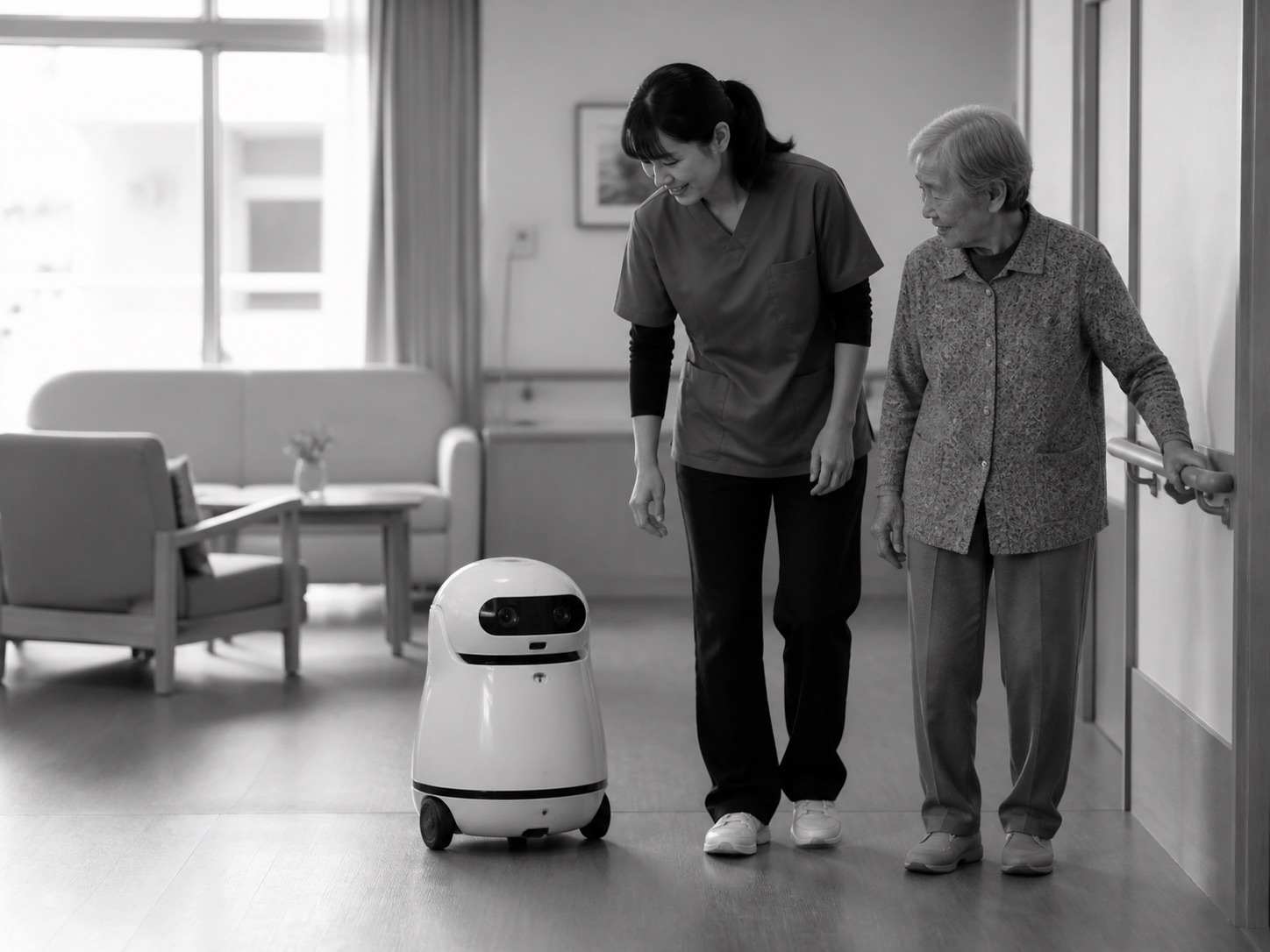
The most useful care technology does not replace a caregiver. It gives scarce people more time for the parts of care that machines cannot do.
What Taiwan’s chip strategy means beyond the factory floor
Taiwan’s semiconductor policy is about resilience as much as growth: keep the ecosystem deep, keep customers close, and make the island difficult to replace overnight.
Why AI adoption looks different across Asian companies
The gap between an AI demo and useful adoption is usually organisational. Industry, language, regulation, data quality, and management habits decide what happens after the pilot.
What global coverage misses about ageing in Asia
“Asia is ageing” is true but incomplete. The pace, shape, and institutional consequences differ enough that one regional story can hide the decisions each society has to make.